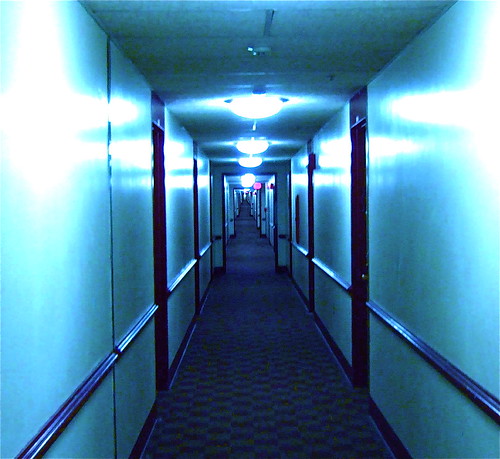
I’m the furtive inspector of dimly lit corridors,
Dead light bulbs and red exit signs,
Doors that show traces
Of numerous attempts at violent entry,
Is that a rustle of counterfeit bills
Being counted in the wedding suite?
A comb passing through a head of gray hair?
The sound of a maid making a bed?
Eternity is a bathroom full of spider webs,
Dostoyevsky wrote.
I better get the passkey and see for myself.
I better bring some matches too.
-Charles Simic “Night Clerk in a Roach Motel”
Dostoyevsky wrote that we
“always imagine eternity as something beyond conception, something vast, vast! But why must it be vast. Instead of all that, what if it’s one little room, like a bathhouse in the country, black and grimy with spiderwebs in every corner, and that’s all eternity is? I sometimes fancy it like that.”
What does eternity look like from where I’m standing? It’s like trying to make out shapes in wisps of clouds; then using those interpretations to predict the heat death of the universe. Attempting to explain it incurs some formidable obstacles. There’s a passage in Marcel Proust’s Swan’s Way wherein he describes the experience of reading during a summer day as an allegory for the use of metaphor to facilitate understanding.
The dark coolness of my room related to the full sunlight of the street as the shadow relates to the ray of light, that is to say it was just as luminous and it gave my imagination the total spectacle of the summer, whereas my senses, if I had been on a walk could only have enjoyed it by fragments; it matched my repose which (thanks to the adventures told by my book and stirring my tranquility) supported, like the quiet of a motionless hand in the middle of a running brook the shock and the motion of a torrent of activity.
The sunlight through the window as metonymical representation of summer is, to Proust, more expressive of the season than a walk outside fully immersed in all its aspects, just as a hand inserted into a flowing stream provides the sudden shock of perceiving the full flow and force of the water. The quest for truth is one fraught with blindness, it expounds in Plato’s Allegory of the Cave. The escaped prisoner, upon making his way into the world is blinded by the intensity of the Sun.
He is reluctantly dragged up a steep and rugged ascent, and held fast until he 's forced into the presence of the sun himself, is he not likely to be pained and irritated? When he approaches the light his eyes will be dazzled, and he will not be able to see anything at all of what are now called realities.
Consider the Sun to be eternity in this case. According to Immanuel Kant in his “Critique of Judgement”, “That is sublime in comparison with which everything else is small.” The quest to understand infinity falls into this category. Infinity is a sublime concept beyond human cognition, it is the blinding light waiting at the end of the cave. So what brook must we dip our hand into before grasping the shock of eternity in a bathroom full of spiderwebs?
In attempting to find a tangible embodiment of eternity, we need look no further than the physical manifestations of society. The sublime is too unfathomable to be held in the mind as a singular whole. As such, the question of eternity becomes the question of what eternity means for us. Our world is comfortingly flat. Where does humanity end, where do the many paths of lives intersect and become one, hovering above time and space?
There are a thousand miles of hallways strung throughout the world where carbon copy people pay to sleep in numbered rooms that look the same. The endless roads of their arrivals yield only one result. A reprieve, a shelter from the storm, a place to make a buck; a bed, a dresser, a bathroom, the smell of whiskey and mold: ephemeral. There isn’t any permanence to a hotel room, no matter the circumstances, it’s a station on your way, never a home, seldom a solace. Transience, and debauchery, the abandonment of the individual, but at a price. It’s what all of humanity can be reduced to.
Leonard Cohen captures the moment in time of the hotel room with his song Chelsea Hotel #2.
I remember you well in the Chelsea Hotel
You were famous, your heart was a legend.
You told me again you preferred handsome men
But for me you would make an exception.
And clenching your fist for the ones like us
Who are oppressed by the figures of beauty,
You fixed yourself, you said, 'Well never mind,
We are ugly but we have the music.'
A hotel room holds a thousand stories and a piece of every soul that’s wondered in. The vague signs of repeated occupation tell fragments of stories, the blood spatter on the carpet and the lingering smell of perfume speak of a past whose details are lost amidst the trickle of a stream of humanity.
In his diaries Cesare Pevase wrote,
“We don’t remember days, we remember moments.” Our lives are divided into segments, a mountain range stretching across two continents whose peaks can be counted on your fingers. He also wrote,
"Traveling is a brutality. It forces you to trust strangers and to lose sight of all that familiar comfort of home and friends. You are constantly off balance. Nothing is yours except the essential things - air, sleep, dreams, the sun, the sky - all things tending toward the eternal or what we imagine of it." To travel to the hotel is to experience nothing but the essential fragments of the eternal. In his poem, “Deola’s Return”, Pevase distills humanity into the acts of the individual, the severing of social connections and the often unrealized totality of being alone.
Deola's Return
I'll turn round in the street and look at the passers-by,
I'll be a passer-by myself. I'll learn
how to get up and lay aside the horror
of night and go out walking as I used to.
I'll apply my mind to work for a time,
I'll go back there, by the window, smoking
and relaxed. But my eyes will be the same,
my gestures too, and my face. That empty secret
that lingers in my body and dulls my gaze
will die slowly to the rhythm of the blood
where everything vanishes.
I'll go out one morning,
I won't have a house any more, I'll go out in the street;
the night's horror will have left me;
I'll be frightened of being alone. But I'll want to be alone.
I'll look at passers-by with the dead smile
of someone who's beaten, but doesn't hate or cry out,
for I know that since ancient times fate -
all that you've been or will ever be - is in the blood,
in the murmur of the blood. I'll wrinkle my brows
alone, in the middle of the street, listening for an echo
in the blood. And there'll be no echo any more,
I'll look up and gaze at the street.
Pevase was tortured by feelings of isolation and betrayal, he checked into a small hotel room in Turin and overdosed on sleeping pills. With his death, he turned the transient into the eternal. A temporary holding cell of life became death, more permanent than any action, a statue more lasting than bronze. In the second chapter (Pindarics, after Cesare Pavese) of his book, Without Title, Geoffrey Hill writes an extensive analysis of Pevase including this stanza.
Ovid would have our number, definitely.
Look at yourself, it makes no difference
that the mirror is upside down. Judicial
stay on writ won at eleventh hour
changes nothing. Small hotels are to die in.
The hotel is the unity of eternity and the moment, of humanity and its constructs, of space and its simulacrums. It is the end of love and the end of life. Eternity is a number on your keychain.


