I did a recording of one of my favorite Eliot poems.
Monday, November 7, 2011

Friday, April 10, 2009
A Bitter Thaw

Sometimes I lie awake regretting
The bitter Prozac pills that have poisoned my nights
And the cold breeze that drifts through the window
When I kill the music and dim the lights.
I doffed my coat, abandoned being warm,
I stood outside your doorstep and begged
To be let me into the storm.
And icicle stalactites
Dripped into the ceaseless spread of snow
That swallowed words and tears.

The snow fell without your consent
And I suppose that I froze when you poisoned the rose
And started this icy decent
I can’t hear the morning dove
I’ve been sleeping with the crow
I left my body here
And made my bed of snow

What can you deny a man frozen in time?
Was there time before the fall?
What words suffice on lips of ice?
You can deny him nothing at all.
Monday, April 6, 2009
Battlefields from Here to Barcelona.
This was originally conceived as a compliment to a series of photos (some of which have been included) but as poems are want to do, it adapted. The basic intent to rectify a Kantian view of the sublime with a more modern, cynical outlook on religion.

Where is God?
Is he the instrument?
Or can we be drawn by human spark
To hold the dream of origin?
Sublime grandeur a settling fog
Moved by hand of God
To make moist eyes glisten
Drowned in tepid twilight.
Let the reverent lens resolve
Watch light fail to elucidate
And throw your alms upon the alter
Crucify the martyrs upside down.
Wait out the waning glare of God’s grace.
Or plunge fat hands into the embers,
Rekindle faith with blazing flesh,
Be a beacon in the dying light.
We created heaven.
On the day before the first,
Nature’s feckless fecundity
Found insufficient for salvation.

Following the footsteps of giants,
Fling great shadows skywards
For fit monument;
Elegies to our eternity.
It was the solitary heart,
A restless yearning to penetrate
The sublime primal world
When vanity was young.
Shuffle your feet
Through autumn’s ossuary,
The perdurable grind of fallen leaves
On fields from Ypre to Aushwitz.

He has grown old and bitter,
Since the empire’s decline and fall,
Shakespeare shattered for want of ink,
When the scenery started fading,
It’s the ruse of binary opposition,
The rut of mutual codependence,
The apprentice in the artisan’s workshop,
The bullet in the brainpan in a bunker in Berlin.
Where is God?
Is he the instrument?
Or can we be drawn by human spark
To hold the dream of origin?
Sublime grandeur a settling fog
Moved by hand of God
To make moist eyes glisten
Drowned in tepid twilight.
Let the reverent lens resolve
Watch light fail to elucidate
And throw your alms upon the alter
Crucify the martyrs upside down.
Wait out the waning glare of God’s grace.
Or plunge fat hands into the embers,
Rekindle faith with blazing flesh,
Be a beacon in the dying light.
We created heaven.
On the day before the first,
Nature’s feckless fecundity
Found insufficient for salvation.
Following the footsteps of giants,
Fling great shadows skywards
For fit monument;
Elegies to our eternity.
It was the solitary heart,
A restless yearning to penetrate
The sublime primal world
When vanity was young.
Shuffle your feet
Through autumn’s ossuary,
The perdurable grind of fallen leaves
On fields from Ypre to Aushwitz.
He has grown old and bitter,
Since the empire’s decline and fall,
Shakespeare shattered for want of ink,
When the scenery started fading,
It’s the ruse of binary opposition,
The rut of mutual codependence,
The apprentice in the artisan’s workshop,
The bullet in the brainpan in a bunker in Berlin.
Even Damnation is Poisoned with Rainbows.

We perceive the world through contrast. It is impossible to discern objects, concepts, or emotions as things in themselves, only as what they are not. There are no absolutes or fundamental truths when it comes to human existence; there is only what is and what is not. The problem with that statement is that it is itself an absolute, and as such it states a literal absolute that rhetorically admits the existence of counter examples. So, what is the intention of this argument?
I’m making an attempt to explain why Thomas Hobbes can say that life in the state of nature is "solitary, poor, nasty, brutish and short" and be correct while still allowing for the existence of happiness and comfort. The first task, then, is to explain what I mean by contrast. The following passage, from Herman Melville’s Moby Dick describes a scene in which Ishmael and Queequeg shelter in their bed on a cold morning.
“We felt very nice and snug, the more so since it was so chilly out of doors; indeed out of bed-clothes too, seeing that there was no fire in the room. The more so, I say, because truly to enjoy bodily warmth, some small part of you must be cold, for there is no quality in this world that is not what it is merely by contrast. Nothing exists in itself. If you flatter yourself that you are all over comfortable, and have been so a long time, then you cannot be said to be comfortable any more. But if, like Queequeg and me in the bed, the tip of your nose or the crown of your head be slightly chilled, why then, indeed, in the general consciousness you feel most delightfully and unmistakably warm. For this reason a sleeping apartment should never be furnished with a fire, which is one of the luxurious discomforts of the rich.”
It is these ‘luxurious discomforts of the rich’ that make it possible for the borderline poor and the incredibly wealthy to exist at relatively even levels of happiness. As Don Quioxte said, “Hunger is the best sauce in the world.” There have been many times when I’ve rejected a chance at comfort or happiness. Sometimes for the benefit of others, sometimes out a kind of masochism that thinks I’ve lived too long with pain to know who I am without it. It’s the perpetual paradox of the pessimist that when you always expect the worst, you’re always right or pleasantly surprised. The lower bound of this kind of cynicism can be glimpsed in this quote from Orson Scott Card’s short story The Originist from Maps in a Mirror.
“There is no such thing as an unbreakable bond between people. Nothing can last. Nothing is, finally, what it once seemed to be. Anyone who thinks he has a perfect marriage, a perfect friendship, a perfect trust of any kind, he only believes this because the stress that will break it has not yet come. He might die with the illusion of happiness, but all he has proven is that sometimes death comes before betrayal. If you live long enough, betrayal will inevitably come.”

Life is in the struggle, what I am is what I’ve done and what’s been done to me. I know I’d never be content if it weren’t for the constant reminder of the alternative. I can stop short of deliberately ruining a relationship while still being able to say, “I have to go, I’m almost happy here.” Real people don’t ride off into the sunset. When the sun sets you still have to make dinner and do the dishes. To me, happiness isn’t getting what you want, it’s knowing what you want and being able to grasp at it piece by piece while the whole remains out of reach. The source of the English word tantalizing comes from the story of Tantulus, son of Zues. As a punishment for revealing the secrets of the gods, Tantulus was forced to stand in a pool of water with branches of luscious fruit trees hanging overhead. Whenever he reached for the fruit, the wind blew the branches out of his reach. When he bent down, the water receded before he could drink. The torment of Tantulus is the fate of all mankind. We are surrounded by the pleasures of this world, but if we devote ourselves to seeking them we doom ourselves to being miserable. Happiness is being able to appreciate a lack, and more importantly to be able to enjoy the attempted acquisition of happiness as a blessing in itself.
Monday, March 16, 2009
Small Hotels are to Die in.
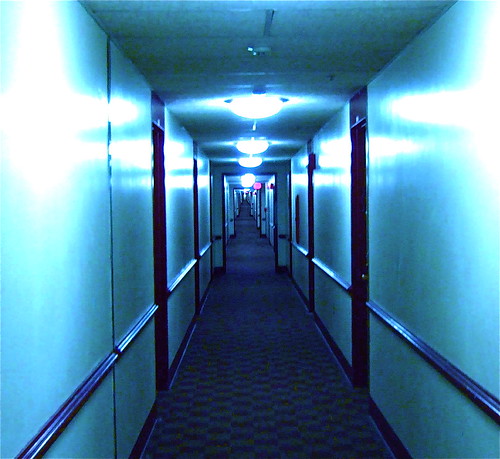
I’m the furtive inspector of dimly lit corridors,
Dead light bulbs and red exit signs,
Doors that show traces
Of numerous attempts at violent entry,
Is that a rustle of counterfeit bills
Being counted in the wedding suite?
A comb passing through a head of gray hair?
The sound of a maid making a bed?
Eternity is a bathroom full of spider webs,
Dostoyevsky wrote.
I better get the passkey and see for myself.
I better bring some matches too.
-Charles Simic “Night Clerk in a Roach Motel”
Dostoyevsky wrote that we “always imagine eternity as something beyond conception, something vast, vast! But why must it be vast. Instead of all that, what if it’s one little room, like a bathhouse in the country, black and grimy with spiderwebs in every corner, and that’s all eternity is? I sometimes fancy it like that.”
What does eternity look like from where I’m standing? It’s like trying to make out shapes in wisps of clouds; then using those interpretations to predict the heat death of the universe. Attempting to explain it incurs some formidable obstacles. There’s a passage in Marcel Proust’s Swan’s Way wherein he describes the experience of reading during a summer day as an allegory for the use of metaphor to facilitate understanding.
The dark coolness of my room related to the full sunlight of the street as the shadow relates to the ray of light, that is to say it was just as luminous and it gave my imagination the total spectacle of the summer, whereas my senses, if I had been on a walk could only have enjoyed it by fragments; it matched my repose which (thanks to the adventures told by my book and stirring my tranquility) supported, like the quiet of a motionless hand in the middle of a running brook the shock and the motion of a torrent of activity.
The sunlight through the window as metonymical representation of summer is, to Proust, more expressive of the season than a walk outside fully immersed in all its aspects, just as a hand inserted into a flowing stream provides the sudden shock of perceiving the full flow and force of the water. The quest for truth is one fraught with blindness, it expounds in Plato’s Allegory of the Cave. The escaped prisoner, upon making his way into the world is blinded by the intensity of the Sun.
He is reluctantly dragged up a steep and rugged ascent, and held fast until he 's forced into the presence of the sun himself, is he not likely to be pained and irritated? When he approaches the light his eyes will be dazzled, and he will not be able to see anything at all of what are now called realities.
Consider the Sun to be eternity in this case. According to Immanuel Kant in his “Critique of Judgement”, “That is sublime in comparison with which everything else is small.” The quest to understand infinity falls into this category. Infinity is a sublime concept beyond human cognition, it is the blinding light waiting at the end of the cave. So what brook must we dip our hand into before grasping the shock of eternity in a bathroom full of spiderwebs?
In attempting to find a tangible embodiment of eternity, we need look no further than the physical manifestations of society. The sublime is too unfathomable to be held in the mind as a singular whole. As such, the question of eternity becomes the question of what eternity means for us. Our world is comfortingly flat. Where does humanity end, where do the many paths of lives intersect and become one, hovering above time and space?
There are a thousand miles of hallways strung throughout the world where carbon copy people pay to sleep in numbered rooms that look the same. The endless roads of their arrivals yield only one result. A reprieve, a shelter from the storm, a place to make a buck; a bed, a dresser, a bathroom, the smell of whiskey and mold: ephemeral. There isn’t any permanence to a hotel room, no matter the circumstances, it’s a station on your way, never a home, seldom a solace. Transience, and debauchery, the abandonment of the individual, but at a price. It’s what all of humanity can be reduced to.
Leonard Cohen captures the moment in time of the hotel room with his song Chelsea Hotel #2.
I remember you well in the Chelsea Hotel
You were famous, your heart was a legend.
You told me again you preferred handsome men
But for me you would make an exception.
And clenching your fist for the ones like us
Who are oppressed by the figures of beauty,
You fixed yourself, you said, 'Well never mind,
We are ugly but we have the music.'
A hotel room holds a thousand stories and a piece of every soul that’s wondered in. The vague signs of repeated occupation tell fragments of stories, the blood spatter on the carpet and the lingering smell of perfume speak of a past whose details are lost amidst the trickle of a stream of humanity.
In his diaries Cesare Pevase wrote, “We don’t remember days, we remember moments.” Our lives are divided into segments, a mountain range stretching across two continents whose peaks can be counted on your fingers. He also wrote, "Traveling is a brutality. It forces you to trust strangers and to lose sight of all that familiar comfort of home and friends. You are constantly off balance. Nothing is yours except the essential things - air, sleep, dreams, the sun, the sky - all things tending toward the eternal or what we imagine of it." To travel to the hotel is to experience nothing but the essential fragments of the eternal. In his poem, “Deola’s Return”, Pevase distills humanity into the acts of the individual, the severing of social connections and the often unrealized totality of being alone.
Deola's Return
I'll turn round in the street and look at the passers-by,
I'll be a passer-by myself. I'll learn
how to get up and lay aside the horror
of night and go out walking as I used to.
I'll apply my mind to work for a time,
I'll go back there, by the window, smoking
and relaxed. But my eyes will be the same,
my gestures too, and my face. That empty secret
that lingers in my body and dulls my gaze
will die slowly to the rhythm of the blood
where everything vanishes.
I'll go out one morning,
I won't have a house any more, I'll go out in the street;
the night's horror will have left me;
I'll be frightened of being alone. But I'll want to be alone.
I'll look at passers-by with the dead smile
of someone who's beaten, but doesn't hate or cry out,
for I know that since ancient times fate -
all that you've been or will ever be - is in the blood,
in the murmur of the blood. I'll wrinkle my brows
alone, in the middle of the street, listening for an echo
in the blood. And there'll be no echo any more,
I'll look up and gaze at the street.
Pevase was tortured by feelings of isolation and betrayal, he checked into a small hotel room in Turin and overdosed on sleeping pills. With his death, he turned the transient into the eternal. A temporary holding cell of life became death, more permanent than any action, a statue more lasting than bronze. In the second chapter (Pindarics, after Cesare Pavese) of his book, Without Title, Geoffrey Hill writes an extensive analysis of Pevase including this stanza.
Ovid would have our number, definitely.
Look at yourself, it makes no difference
that the mirror is upside down. Judicial
stay on writ won at eleventh hour
changes nothing. Small hotels are to die in.
The hotel is the unity of eternity and the moment, of humanity and its constructs, of space and its simulacrums. It is the end of love and the end of life. Eternity is a number on your keychain.
Subscribe to:
Comments (Atom)